
I got sick in the middle of our busiest quarter about ten year ago. Nothing dramatic, just the kind of sick where you’re down for four or five days and genuinely cannot function. I handed off what I could, sent a few messages, and told myself the team had it.
When I came back, I spent the first two hours of my first day back just catching up on what hadn’t moved. A follow-up that should have gone out Tuesday sat untouched. A prospect we’d been in conversation with for six weeks never heard from anyone while I was out. A client question that came in Wednesday was still sitting in my inbox Friday with no one having replied.
The team wasn’t incompetent. They weren’t lazy. Most of them are genuinely talented people. What I had done, without realizing it, was build a business where the most important decisions had an invisible path back to me. Not because I demanded it. Because I hadn’t built anything else.
That week made something very clear: I wasn’t running a business. I was the business.
The Week That Tells You Everything
Most founders figure this out the hard way. A vacation where the phone never stops. A week where you step back to see what happens, and what happens is not much. A quarter where the team is working hard but the pipeline sits flat because the person who usually pushes it forward is you.
It doesn’t feel like a structural problem at first. It feels like a leadership problem, or maybe a hiring problem, or maybe you just need to communicate better. So you hold more meetings. You create more check-ins. You stay a little later. You push a little harder. And things start moving again, which confirms your belief that you just needed to be more present.
But presence is not a system. And eventually that distinction costs you something significant, either in the business or at home.
The business follows you out the door. Not in the stack of folders you bring home, but in the part of your brain that never fully disconnects. You’re at dinner, and you’re thinking about the proposal. You’re at your kid’s game, and you’re calculating cash flow in the back of your mind. You’re on vacation, and you’re technically there but not quite present. Your family knows it. You know it. And yet the business still needs you, so you stay plugged in.
That’s not ambition. That’s dependency. And it runs in both directions.
What’s Actually Happening
Here’s the part that took me longer than I’d like to admit to understand: the business isn’t doing this to you. You built it this way. Not intentionally, not carelessly, but gradually and organically over years of solving problems faster than anyone else, of being the person who remembered everything, of being the one who could close the deal, who knew the client’s backstory, who understood the nuance that no one else had time to understand.
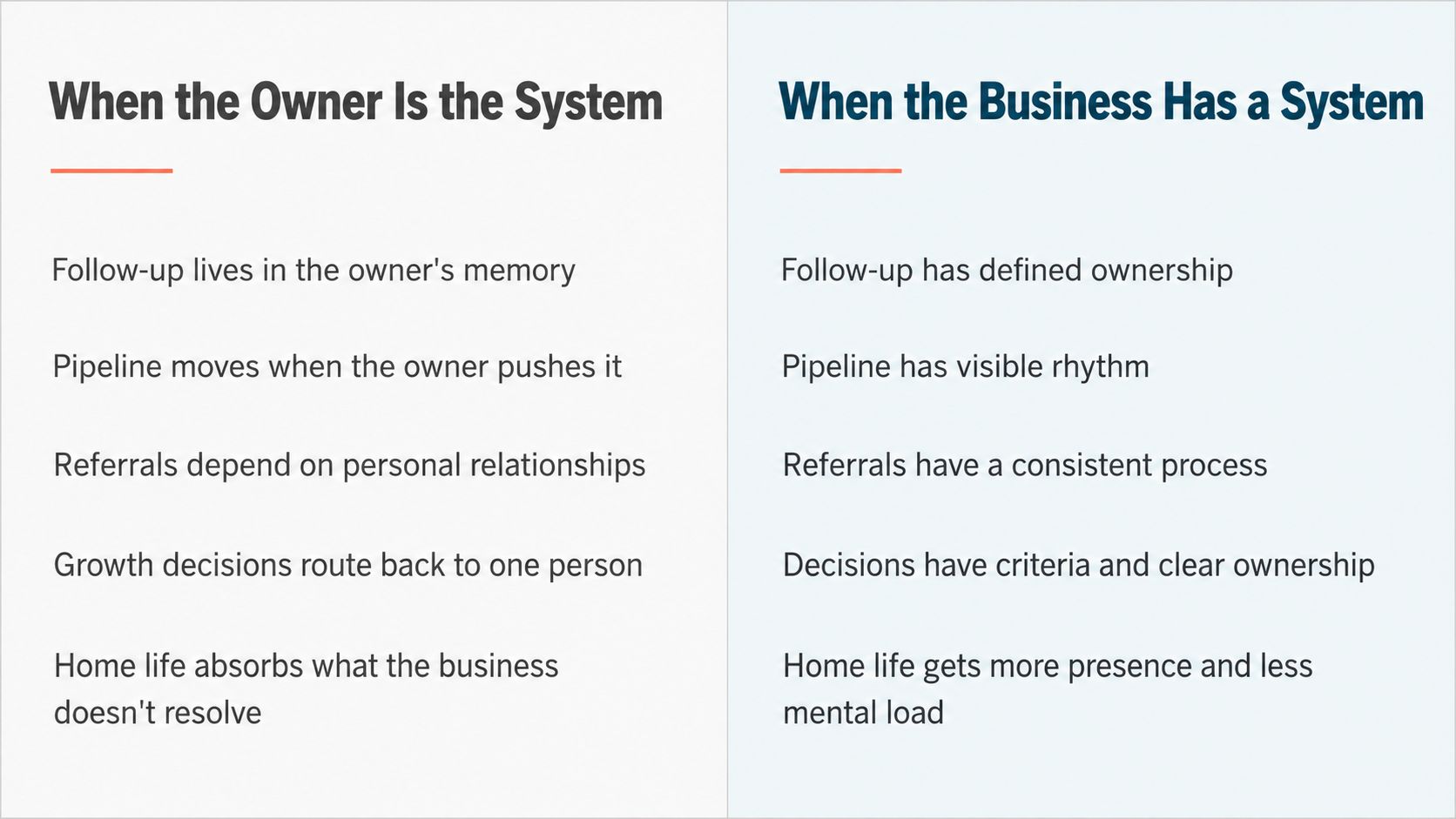
Over time, that turned into a system where you are the memory, the follow-up trigger, the quality check, the relationship hub, and the growth engine. Your team moves when you push. Pipeline grows when you’re personally in it. Marketing gets done when you notice it’s been quiet. Referrals come in because of your relationships, not because of a process that generates them consistently.
This is what I call a Reactive Rhythm. Growth doesn’t have its own cadence. It has yours. When you’re energized, it moves. When you step back, it slows. When life pulls your attention, the business feels it.
And here’s the real problem: a business with a Reactive Rhythm cannot scale. Not in any meaningful way. Not because the team isn’t capable, but because the team is calibrated to wait for you. They’ve learned, consciously or not, that decisions get made faster when you’re in the room. That follow-up happens when you remind them. That the growth activities you’ve been meaning to systematize are still sitting on a whiteboard somewhere.
The ceiling isn’t the market. It isn’t competition. It isn’t lead volume. It’s you.
What It Costs at Home
I want to be honest about the part that actually motivated me to fix this.
I was not fully present at home for a long time. I thought I was. I was physically there most of the time, ate dinner with my family, made it to a lot of events. But my wife Rachel will tell you, and she’s right, that I was often only half there. The other half was still inside the business. Working through a problem. Running a scenario. Replaying a conversation from earlier in the day.
My daughters, Lexi and Ella, were growing up around a version of me that was doing his best but was also quietly carrying a company in his head at all times. That’s the part no one talks about when they talk about owner dependency. It’s not just a business problem. It drains the presence you have available for the people who matter most.
When your business requires you to hold everything together, it takes something from every other relationship in your life. You get home with less patience than you want to have. You go to bed still processing something you didn’t resolve. You’re physically in the vacation, but part of your mind is doing inventory on what’s going sideways while you’re away.
That’s the real cost. Not the deals that don’t close while you’re sick. Not the flat quarter when you finally take a break. The real cost is the version of yourself that shows up at home, and what that version costs your family over years.
The Shift That Changed Things
I didn’t fix this overnight. I want to be clear about that because too many articles on this topic make it sound like you just need to delegate better or document your processes and suddenly the business runs itself. That’s not how it works.
What changed for me was understanding that the goal wasn’t to get the business to run without me entirely. The goal was to build a growth system that didn’t require my constant presence to function. Pipeline needed its own rhythm, not mine. Follow-up needed to live in a process, not my memory. The marketing cadence needed to run on a schedule, not on the weeks when I noticed it had gone quiet.
That sounds straightforward until you realize how much of your growth depends on informal decisions, personal relationships, and your own intuition about what the business needs next. Moving those things into a system feels like losing control at first. It’s actually the opposite.
When the growth system has its own rhythm, you stop carrying it home. When follow-up has an owner that isn’t you, you stop doing the mental accounting at dinner. When pipeline visibility is real and not dependent on your gut, you can actually be off for a week and not come back to a disaster.
That’s what I was trying to build. Not a business I could disappear from, but one where my absence didn’t mean stall.
The Question Worth Sitting With
If you stepped away from your business for two weeks, genuinely disconnected, what would move and what would stop?
Not what should move. What would actually move without you pushing it.
If the honest answer is “not much,” that’s not a reflection of your team. It’s a reflection of the system they’re operating inside. A system that was built around you because you were the fastest path to every answer, every decision, and every push forward.
That system served you well when you were building. It’s now the thing getting in the way of both growth and the life you said you were building the business to support.
You can’t get time back with your kids. You can’t undo the vacations where you were present in body but not in mind. But you can make a different choice about what you build from here.
The growth system I rely on now runs without me holding it together. Pipeline moves. Follow-up has owners. Marketing has rhythm. That didn’t happen because I delegated better. It happened because I stopped being the system and started building one.
If your business slows when you slow, that’s not hustle. That’s the system telling you something. Worth paying attention to.
If some of this felt familiar, it’s probably worth understanding where the dependency lives inside your growth system specifically. The first step is usually just seeing it clearly.
Start with the Revenue Leak Finder from my business StringCan. It’s a short diagnostic that helps you identify where growth is stalling and what’s most worth fixing first. No sales call required to get started.
Frequently Asked Questions
What does it mean when a business only works when the owner is involved?
It means the business was built around the owner’s personal involvement rather than a system that can function independently. When decisions, follow-up, client relationships, and growth activity all route through one person, the business doesn’t have an operating rhythm. It has the owner’s rhythm. That creates a ceiling on growth and a guaranteed drain on the owner’s personal life outside of work.
How do I know if I’m the bottleneck in my own business?
The clearest signal is what happens when you step back. If pipeline slows, if follow-up stops, if decisions wait until you return, if the team seems to move in reaction to your energy rather than a defined process, you’re likely the bottleneck. That’s not a management failure. It’s a structural one. The business was designed, often unintentionally, to route everything through you.
Why does my team wait for me to make decisions even when they don’t need to?
Teams learn over time where decisions actually get made. If you’ve historically been the fastest path to resolution, your team has calibrated to that. It’s not a confidence problem or a training problem in most cases. It’s a process problem. When there’s no defined ownership, no clear criteria for decisions, and no visible system to reference, waiting for the owner is the rational choice.
What is owner dependency in a business?
Owner dependency is when the growth, operations, or decision-making of a business relies on the sustained personal involvement of the founder or owner to function. It shows up as inconsistent pipeline when the owner isn’t pushing, client relationships that only the owner can manage, follow-up that lives in the owner’s memory, and marketing that starts and stops based on the owner’s attention. It’s one of the most common patterns in owner-led companies between $5M and $30M in revenue.
How do I start building a business that doesn’t depend on me being constantly involved?
Start by identifying where the dependency actually lives. Most owners assume it’s everywhere. In practice it’s usually concentrated in three or four specific places: pipeline creation, follow-up ownership, key client relationships, and growth decision-making. When you can see exactly where you’re the system, you can start replacing yourself with process, ownership, and visibility. That’s the beginning of building a business that supports your life rather than consuming it.
Please note: I reserve the right to delete comments that are offensive or off-topic.